
Sacred Music in the 15th Century
by Don Robertson (2016)
The year 1400 is the approximate date for the introduction of pure consonance in the sacred choral music of Europe. This introduction was courtesy of the English composer named John Dunstable (1390-1453), who added the consonant musical intervals of the 3rd and 6th to multi-voiced sacred music that during the previous century had been more restricted to the perfect forth and fifth intervals. Due to the tremendous resonant power that music has, adding the 3rd and 6th, which completed the harmony of the three-note chord called the triad, provided the basis for consonant harmony, resonating with the tremendous social change that accompanied the beginning of rebirth in Europe, already stimulated by the influence of the Islamic culture of Al Andalus (Spain) that I discussed in the article “The Seeds of the Renaissance”.
John Dunstable (ca 1390 – 1453)
The polyphonic music style of previous centuries had been based primarily on the root harmonic intervals of the perfect forth and fifth. What Dunstable did was provide his music with an abundance of what became known as the contenance angloise, balancing the interval of the perfect forth and fifth by adding the 3rd and sixth intervals. John Dunstable gave to European music the balance of music based on the musical triad (C E G).
John Dunstable was very famous and his music very important. Most of it, however, has vanished, destroyed in the dissolution of the monasteries that occurred during 1536-1541, when Henry the Eighth destroyed catholicism in Britain.

14th Century
15th Century
It was music from the Netherlandish countries – the area of Northern Europe now known as Northern and Eastern France, Belgium, and the Netherlands – that the most important 15th-century music arose. This was the music of the Franco-Flemish School of composers who were joined by the visual artists who helped create the great cultural movement of that time, producing some of our greatest works of art.
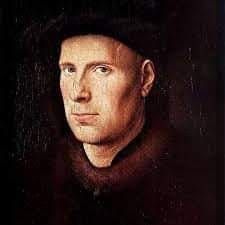
The following two paintings are among the most famous from the Franco-Flemish world during this time of great cultural achievement:


A great experience for me was the day that I spent in the Old Masters Museum in Brussels, where so many of these old paintings are on display. Already familiar with the music that at one time was coexistent with this art, this was a very special treat.
Guillaume Dufay (ca 1400 – 1474)
The greatest composer of the Franco-Flemish school was Guillaume Dufay, who created a music with an original style that will dominate the century. Gustave Reese, who wrote the monumental treatise of Renaissance music Music in the Renaissance, had this to say about the composer:

Dufay was one of the most famous men of his generation. He created an entirely new musical style that would influence musical composition permanently, affecting every genre and sphere.
We don’t know where or when he was born, but we do know that he was Flemish and that he began his musical career as a singer in the Burgundian court, and that he was associated with the town of Cambrai in Belgium, which at that time was under Burgundian rule. He moved to Italy in 1420, however. He was already famous by the 1420s, having written two wonderful works: the secular “Adieu ces bons vins de Lannoys” (Goodbye to These Good Wines of Lannoys) and the sacred “Apostolo glorioso” (Glorious Apostle).
“Adieu ces bons vins de Lannoys”
“Apostolo glorioso”
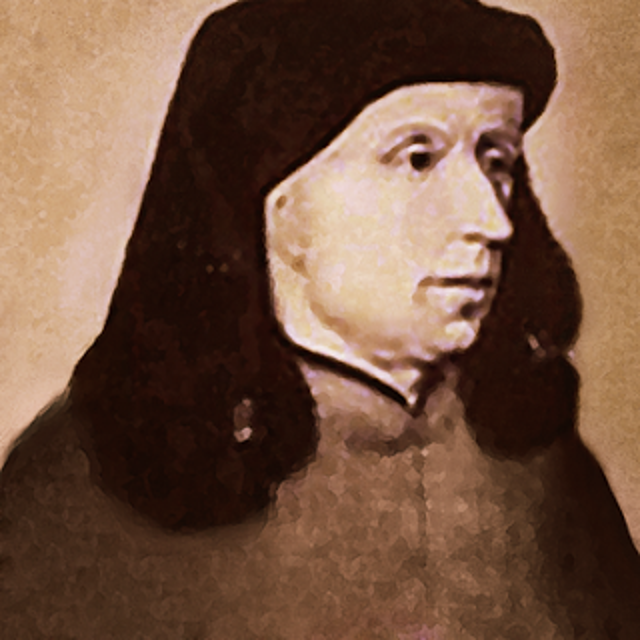
Johannes Ockeghem (ca 1410 – 1497)
Johannes Ockeghem was born in the French-speaking province of Hainaut, in the town of Saint-Ghislainor according to recent research. He was the first chaplain for three French kings, and he held the prestigious position of treasurer at the great cathedral and monastery of St. Martin de Tours.
Ockeghem’s surviving musical output is small, consisting of only a few motets, fourteen masses, and a couple of dozen chansons. Unfortunately, what was most likely a large output of music has been destroyed, perhaps in the over one-hundred conflicts and wars that plagued Europe during the 15th and 16th centuries. Ockeghem was known as an accomplished master of compositional technique, famous for his complex lines and polyphonic structures. He wrote some very beautiful music.
Missa Mi-Mi
Missa Ecce ancilla Domini “Kyrie”
Gilles Binchois (ca 1400 – 1460)
Gilles Binchois was one of the most famous of the Franco-Flemish composers from the first half of the 15th century. He wrote secular songs of the highest order and liturgical music as well. Little is known of his life, however.
Dufay and Binchois were represented in “Le Champion des dames”, a poem by Martin le Franc (1410-1461) who penned the phrase contenance angloise, a term that affirmed that these two composers were inspired by the British composer John Dunstable who was the first composer to create the sound that dominated 15th-century music.

Antoine Busnois (ca 1430 – 1492)
Antoine Busnois was a leading French composer, singer, and poet of the early Renaissance. Alongside his contemporary Johannes Ockeghem, he was a central figure of the early Franco-Flemish School and the dominant figure of the Burgundian style following the death of Guillaume Du Fay.
The secular song tradition that Binchois and Dufay began was continued by Antoine Busnois who, like Binchois, became very famous for his songs. His liturgical music, like Dufay’s, filled European cathedrals of the time.
Binchois – De plus en plus
Busnois – Missa O crux lignum “Gloria”
The Polyphonic Music Story Part 2 - The 15th Century (35 minutes)
The Mass
When we refer to a “mass” in Western classical music, we are referring to a setting of the five parts of the ritual of the mass in the Roman catholic church. These are the five sections of the liturgy that are present in almost all celebrations of the mass: the “Kyrie”, the “Gloria”, the “Credo”, the “Sanctus” (and the connected “Benedictus”), and the “Agnus dei”. Together, these five liturgical texts are called the ordinary of the mass. This is invariable except for particular services such as those during holy week (the week before Easter) and in the celebration of the requiem mass (for the dead), where there is a special kind of mass.
When we listen to a “mass” composed by composers from the 14th century forward to the present day, it is usually these five separate liturgical texts sung in Latin (kyrie is a Greek word, however), set to the music from a particular composer, be he Machaut, Dufay, Palestrina, Monteverdi, Bach, Beethoven, or even 20th-century’s Igor Stravinsky. Renaissance composers started a trend of composing sets of the five mass movements that contained similar musical material, to create unity among the five parts.
During the past few centuries, the five mass movements together have become recognized as a complete musical composition using the name “mass”. However, during the Renaissance period, composers created settings of the five mass movements to be included as a part of an overall liturgical service, a service that also contained prayers, lessons, and a reading of the gospel in addition to other parts, much of which were sung in Gregorian chant. The mass movements at that time were not performed outside of the surrounding liturgical service.
During the 15th century, some very beautiful settings of the five sections of the mass ordinary were composed. During the following 16th century, composers will create a very large number of masses. The great 16th century composer Palestrina, who perfected the polyphonic mass, composed over 100 masses, a feat comparable to that of the great 18th-century composer Joseph Haydn who, while perfecting the symphonic and sonata forms, wrote 106 symphonies. You may wish to refer to my article “The Mass Through the Centuries” for more information.
The Motet
The motet is a harmonic liturgical music composition that was often, like the mass movements, sung as a part of various services, replacing Gregorian settings of music for parts of the mass such as graduals, introits, offertories, and antiphons, the music that constituted the proper of the mass and Gregorian chants that were sung in other services such as matins, vespers, compline, and lauds. The earliest extant motets were composed during the 13th century, when music was evolving from the earlier “organum” forms that I described in my article The Seeds of the Renaissance.
Early fifteenth-century motets were mostly isorhythmic, employing repeated rhythmic patterns in all voices… patterns that did not necessarily coincide with repeating melodic patterns.
The Cantus Firmus
As I explaned in my article The Seeds of the Renaissance, when composers began creating sacred music in a harmonic style, such as the organum, harmony parts were added to an existing Gregorian melody. This melodic line appeared as one of the parts, often in long note values, and provided a basis for music composition. It was called the cantus firmus (fixed melody) in writings dating from as far back as 1235.
During the 15th century, the cantus-firmus provided the basis for motet and mass composition. By this time, however, secular melodies that were already beloved by the public also began to be used as a cantus firmus melody. 15th-century composers even employed popular songs as the cantus firmus for compositions sung during the singing of the mass, something that will eventually become an issue with the folks at the Vatican. The most famous example is the melody “L’homme arme“, a French dorian-mode secular song from the same era, whose melody was put to use by a number of composers as a cantus firmus, even including a young 16th-century Palestrina. The most famous example where this melody is employed as cantus firmus is the beautiful mass composed by Guillaume Dufay called the Missa L’homme arme. There are over 40 different settings of the mass ordinary in existance, however.
Example - L'Homme Arme

L’homme armé doibt on doubter.
On a fait partout crier
Que chascun se viegne armer
D’un haubregon de fer.
L’homme armé doibt on doubter.
The armed man should be feared.
Everywhere it has been proclaimed
That each man shall arm himself
With a coat of iron mail.
The armed man should be feared.
Thanks to the wonder of technology, my readers, even those with only a rudimentary understanding of written music, can watch the following video, where the music score is synchronized with the music, and get the point that I am making about how a cantus firmus is integrated into a musical composition. In this video, the choir first sings the popular song “L’homme Arme” to familiarize you with the tune. Following this is the first movement of the mass, the “Kyrie”. In the 5th measure, the melody, an embellished version already hinted at by the sopranos, is sung by the tenor voices. You will see the words “L’OMME L’OMME” in the score, indicating where the old secular melody begins (the “H” in l’homme is not pronounced). After this, there is a pause in the tenor voice as the music continues, and then the melody in the tenor continues for another few measures. The tenor voice works with the melody of the song throughout the mass. The words that are set to this melody are the liturgical words, not the words of the song:
Fauxbourdon
If you are new to 15th-century music, and specifically to the century’s most famous composer Guillaume Dufay, you may sometimes feel the cold-as-steel-like quality in some of the music, showing its roots in the older style from the preceding century, where the focus was on the musical intervals of the 4th and 5th: the underpinnings of all harmony (see my book The Scale for a detailed explanation of this). This is especially evident in the 15th-century musical style known as fauxbourdon that Dufay used for the setting of hymns.
At the beginning of the 15th century, as the Renaissance started to flower, English composer John Dunstable’s influence caused the introduction of the 3rd and 6th musical intervals to become a part of European music composition, thus completing the musical triad, allowing perfect musical harmony to resonate from the halls and cathedrals of Renaissance Europe, as explained above.
The purpose of this type of harmonic innovation was to allow a more chordal setting of the melody. As an example, we turn to the famous Gregorian hymn dedicated to Mary, “Ave Maris Stella” (Hail, Star of the Sea). Like today’s hymns, those of the Renaissance contained poetic lines set to a repeating melody. Dufay’s hymn settings alternated between the original Gregorian melody for odd verses and his own fauxbourdon setting for the even ones:
Wikipedia defines fauxbourdon as: “In its simplest form, fauxbourdon consists of the cantus firmus and two other parts a sixth and a perfect fourth below. To prevent monotony, or to create a cadence, the lowest voice sometimes jumps down to the octave, and any of the accompanying voices may have minor embellishments. Usually just a small part of a motet composition employs the fauxbourdon technique.” [however, entire stanzas are set in Dufay’s hymn settings].

The top and bottom lines are freely composed. The middle line, called the “fauxbourdon”, follows the top line, always remaining exactly a perfect fourth below. The bottom line is often, but not always, a sixth below the top line and is embellished, reaching cadences on the octave.
And now at this point, we move ahead, toward the 16th century, where we will find the composers who followed in the footsteps of Johannes Ockeghem, bridging the gap between the two centuries, moving toward the style that will dominate the 16th century – the golden century of Renaissance sacred music.