The Pakhawaj: An Ancient and Important Rhythmic Art from India
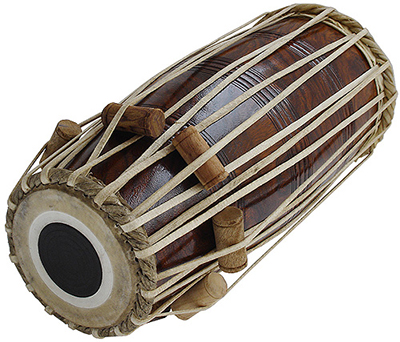
The pakhavaj is a barrel-shaped, two-headed drum, originating from the Indian subcontinent, the oldest version of double-sided drums and its descendants are mridangam of Southern India and kendang of Maritime Southeast Asia and other South Asian double-headed drums. Its older forms were made with clay. It is the percussion instrument most used in the dhrupad style of Indian classical music and less often used as a rhythm accompaniment for various other sub-forms of music and dance performances (e.g. kathak, odissi, marathi). It has a low, mellow tone that is quite rich in harmonics.
The sides of the pakhawaj are made with animal skin (often goat, cow skin). The pakhavaj players place the instrument horizontally in front of themselves as they sit on the floor with legs crossed. The players may sometimes place a cushion under the narrower treble face to lift it slightly. A right-handed person places the larger bass-skin on the left side and the treble skin on the right. The bass face tends to be smeared with some fresh wheat dough which acts as the kiran and gives a vivid bass sound to the pakhavaj. The tuning of Pakhavaj is similar to that of the tabla – with the wooden wedges placed under the tautening straps. Due to the varied thickness of the skin that covers the treble face, the treble face can produce at least two tones that are a semitone apart. For example, if hitting the centre (the bol दिन din) is tuned to produce the note C then hitting closer to the edge (with the bol ता for example) could produce the note C#. The fine tuning can be done with the woven outer ring (गजरा – gajra) which is an extension of the skin that the face is made of. It is only on the bass skin where a freshly made batter (or dough) of (wheat) flour and water is applied to provide enhance the low-pitched sound. While the options to use a polymer-based substitute are available but are not commonly used. (Wikipedia)
The pakhawaj is used in the performance of music in the older Dhrupad and Dhamar styles of music.
Dhrupad: The oldest surviving form of North Indian classical music. The pakhawaj’s deep, resonant tone and complex rhythmic structures perfectly complement the meditative and austere nature of Dhrupad vocal styling.
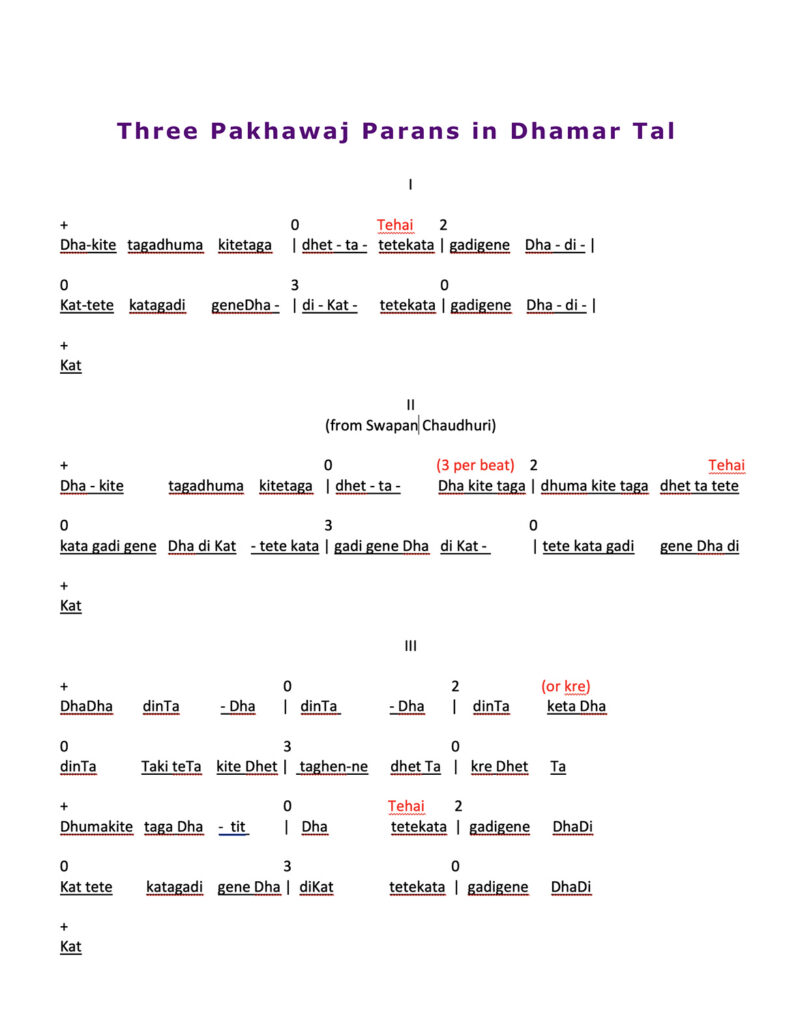
Dhamar: A romantic, lighter form of Dhrupad that is traditionally sung during the spring Holi festival. It relies heavily on the specific 14-beat Dhamar rhythm cycle.
Talas
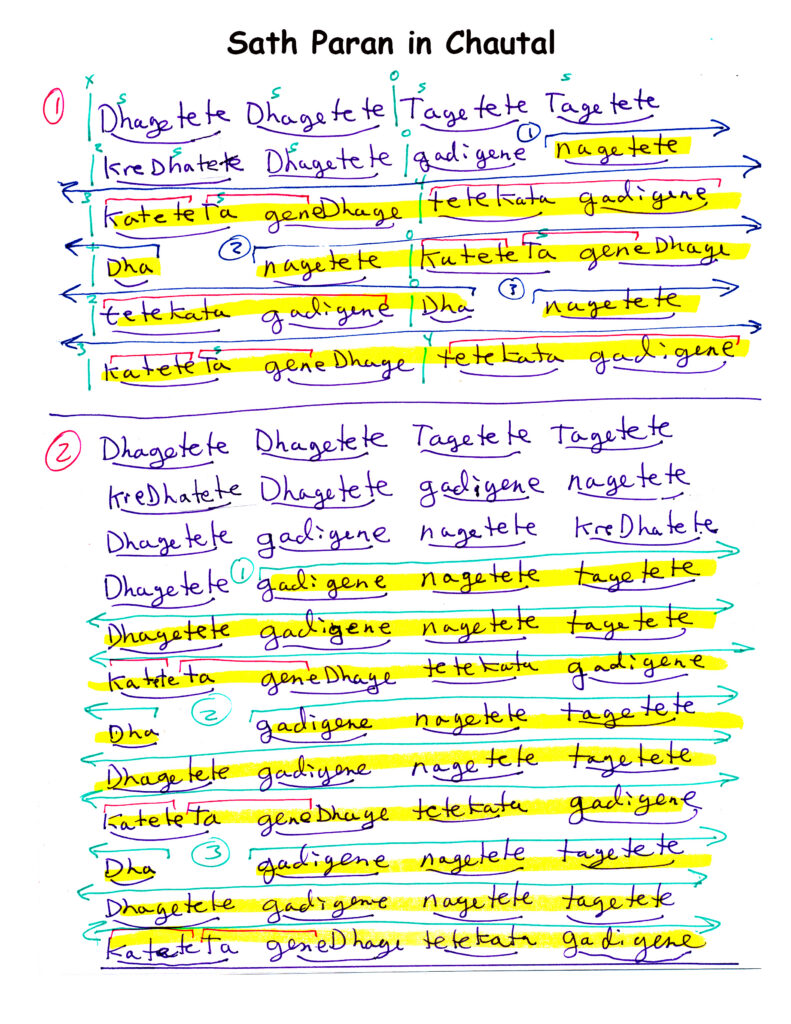
In North Indian (Hindustani) classical music, a tala (or taal) is a repeating rhythmic cycle that provides the rhythmnic structure for a musical piece. Just as a raga provides the melodic framework, a tala provides the temporal framework, measuring time in rhythmic loops, the most common ranging from 6 to 16 beats. In the Dhamar tradition, one tala consisting of 14 beats, is employed. The most common talas in the Drupad tradition are Chautal (12 beats), Sooltal (10 beats), and Aadital (16 beats).
In North Indian (Hindustani) classical music, a theka (often spelled teka) is the foundational, cyclical rhythmic pattern played on percussion instruments like the tabla or pakhawaj. It serves as a structural blueprint, outlining the beats, tempo, claps, and waves of a specific rhythmic cycle, called a taal. A theka is not just a random beat; it is a fixed sequence of mnemonic drum syllables (bols) that communicate specific musical information. For example, this is a theka that can be used for Chautal (12 beats):
A lahara (often spelled lehra) is a repetitive melodic phrase used in North Indian classical music. Literally meaning “wave”, it provides a steady, cyclical background melody that acts as a musical anchor and timekeeper to provide a background for a drum performance. In older times, the melody was provided by a sarangi or violin. However, in the late 19th century, harmoniums were imported from Europe and are used today to provide laharas. Small appliances are manufactured in India to provide laharas for various talas electronically as an aid to practice.
Kuljit Bhamra MBE is a prominent British composer, record producer, and master tabla musician who is widely recognized as a pioneer of the British Bhangra sound.