

Alexander Scriabin (1872 - 1915)
By Don Robertson
© 2005 by Rising World Entertainment
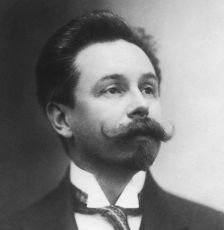
The Russian composer Alexander Nikolayevich Scriabin was born on Christmas Day, January 7, 1872, and died on Easter, April 14, 1915. He was very famous in Russia during his lifetime, recognized as one of the great pianists. He left behind a body of piano compositions, a few orchestral works, a beautiful piano concerto, and five symphonies that were little understood by the public. He continued to be a part of classical music activities in Russia, but outside of Russia, he has been mostly neglected. One of the great composers of the 20th Century, he created a new kind of music.
Scriabin’s earliest influence was Chopin, and his earliest piano pieces were similar in title and length to Chopin’s preludes, etudes, and mazurkas. Many critics branded these works as “diluted Chopin”. However, nothing could be further from the truth. Scriabin’s lush, soaring sonorities were something new, something fresh.
About 1899, Scriabin became absorbed in the music of Richard Wagner, and Wagner’s influence now became stronger than that of Chopin. Scriabin wrote his first symphony that year, a harmonically and melodically rapturous wave of feeling. The final movement included a choir, the text a tribute in praise of Art. The beautiful Symphony Number Two, followed in 1901.
After this, Scriabin began to find a new voice, one that was completely unique, and this voice was first heard in his fourth piano sonata written between 1901 and 1903. New tonalities were explored in this work as root chords contained what musicians call flattened fifths. This tonal structure became even more pronounced in the fifth sonata of 1907 and in all the intervening pieces between these sonatas.
Theosophy and Mysticism
Scriabin was heavily involved in the teachings of Theosophy and mysticism. His whole life and music leaned more and more in this direction as time went on. He also became preoccupied with the creation of positive and negative effects through music. His sixth piano sonata was a negative one. It was so negative, in fact, that he refused to play it. The seventh piano sonata composed during the same time period (1911-1912) he called the “White Mass”, because he considered it of great purity. Its harmonic structure was unlike any created by a composer before.
Scriabin’s fourth symphony was composed between 1905 and 1907. He called it the Poem of Ecstasy, as it was a single movement lasting a half hour, it was really more a poem than a symphony. With this work, the composer wished to stimulate an experience of divine ecstasy in the listener. He wrote a parallel poetic work to help describe the music. It begins:
Spirit
Winged with thirst for life
Is drawn into flight
On the summits of negation.
There, under the rays of its dream,
Emerges a magical world
Of heavenly forms and feelings
Spirit playing,
Spirit desiring.
Scriabin once said to a friend, “When you listen to ‘Ecstasy’ look straight into the eye of the Sun!” The Poem of Ecstasy was followed in 1909-1910 by Prometheus, “The Poem of Fire”. This work, with a completely unorthodox harmonic structure, had a part written in the score for a light keyboard, a keyboard that would be connected to a lighting system that flooded the concert hall with colored lights, the colors defined by the keys pressed on the keyboard and determined by the score.
The Mysterium
Scriabin’s greatest work was to be called the Mysterium. He believed that it would cause a transformation in its listeners. It would contain words, music, dance as well as perfumes and sensations of touch and taste. He worked on the plan for this work throughout the last years of his life. He died prematurely at age fourty-three, never completing the Mysterium.
Scriabin’s music from the fourth sonata on is a mixture of negative and positive compositions, though he never mixed the two opposites in a single piece or movement. The ninth piano sonata he called the “Black Mass”, but the eighth and the final tenth piano sonata, are luxurious travels in the upper astral planes.
Of Scriabin’s music, Manly Palmer Hall said, “One of the most truly spiritual of all musicians was Scriabin, but he must be approached with caution by those whose emotional lives are disorganized.”
Corinne Heline had this to say: “Scriabin was a true messenger and prophet of the Aquarian Age.”
Scriabin and the Harmonic Overtones
In the history of harmony in Western culture, there has been an ever-expanding movement “up” the harmonic overtone series.
During the Renaissance major, minor and diminished triads were used in the music at first, then the 7th was allowed under very specific circumstances. The 7th was liberated at the beginning of the 17th century, and throughout that era chords consisting of 1st, 3rd, 5th and 7th notes of the scale (example: G,B,D,F) were used as a part of the harmony.
Composers in Beethoven’s era began using 9th chords, adding one more note (G,B,D,F,A). However, all five notes were not really used together. It was probably Liszt who began freeing ninth chords as seventh chords had been liberated before, and this inspired Wagner who used them freely. Wagner inspired the French composers who began using straight ninth chords.
From this base, a number of French composers began experimenting with even higher notes of the harmonic series. Most of these composers are unknown today, and only Debussy succeeded in introducing a new music to the Western world using chords of the ninth and beyond.
However, there were two composers who developed music harmonically beyond the 9th chord. The other was Scriabin, who went beyond Debussy in his explorations and brought to us the first music from astral dimensions, music based on these higher partials. Which pieces of music? Works from later in his life: The 8th and 10th Piano Sonatas.