
The Musical Kaleidoscope Story
by Don Robertson
The Kosmon
The Kosmon was a book created by me, my wife at that time, and my best friend.
It was December, 1969, and the “sixties” were over. I had returned to my home state of Colorado after a year of adventures in San Francisco and Mexico and was full of tales, revelations, and observations. My friend John suggested that I write a book. It so happened that John had set up a letterset printing press in his parents’ garage, and he would print it.
We set to work and by the end of summer, we had completed a book about spirituality, music, art, food: a compendium of information that we felt was important for the world to read.
John printed several hundred copies, and they sold like hotcakes in a Denver bookstore.
The Cycle
Excerpt from the Book Hermit in Exile by Don Roberson
The Kosmon begins with an article called “The Cycle”. The ideas that I presented in this article were those that I had been contemplating during the long trip hitchhiking back to the United States from Oaxaca, Mexico. It begins with this statement:
“All ‘progress’ and ‘civilization’ is motivated in such a manner that its movement is in accordance with a cycle.”
During the year 1962, I first began wondering if the stylistic changes that had taken place in art and music over time were possibly governed by a historic cycle. I had been extensively reading the work of the Irish writer James Joyce, and from him, I discovered the 18th century Italian philosopher and historian Giambattista Vico who had written a book called Scienza Nuova (translated into English as New Science) that I read enthusiastically.
Vico believed that throughout history, the rise and fall of empires occurs as a cycle with five distinct stages. During the first stage, people live in a time of necessity, their lives focused on fulfilling their needs while fully recognizing the divinity of creation. The second stage is a time of utility, when people improve their lives with useful tools and methods. The third stage is a time of comfort. The fourth stage finds people amusing themselves with pleasure until finally, during the fifth stage, people grow dissolute in luxury. At the end of this final stage, the people go mad, wasting their time and energy. Vico illustrated his ideas by describing the rise and fall of past cultures in history, such as that of the Roman Empire.
Years later, looking to see if there was a similar historical pattern in the evolution of music and art, I found an interesting description of the evolution of our classical music in a book called Twentieth Century Music, by Peter Yates. Yates stated that there were five distinct periods that the American and European classical music tradition had been traversing. The first period was one where music was concordant: the musical intervals (the space between notes) being acoustically correct, as during the 16th-century Renaissance, for example. During the second period, these intervals were altered when new tunings for the keyboard were introduced to make accommodation for what today is called western harmony: a harmonic system based on the modulation of keys (going from one key to another). This occurred during the 18th century. In the third period – the 19th century – dissonance was introduced, followed by discordance during the fourth period – the first half of the 20th century. Finally, during the fifth period, music becomes noise: a style of music introduced mid-20th century by composer John Cage. As a final stroke, Yates proclaimed in another part of his book: “Music is born from the ordering of noise.” I decided that this statement, probably not intended by the author, was the key to where one cycle ended, and a new one was born.
For Kosmon, I combined these two five-part timelines, created a five-position cycle, added my own commentary, and presented it all in an illustration drawn by John Fresques:
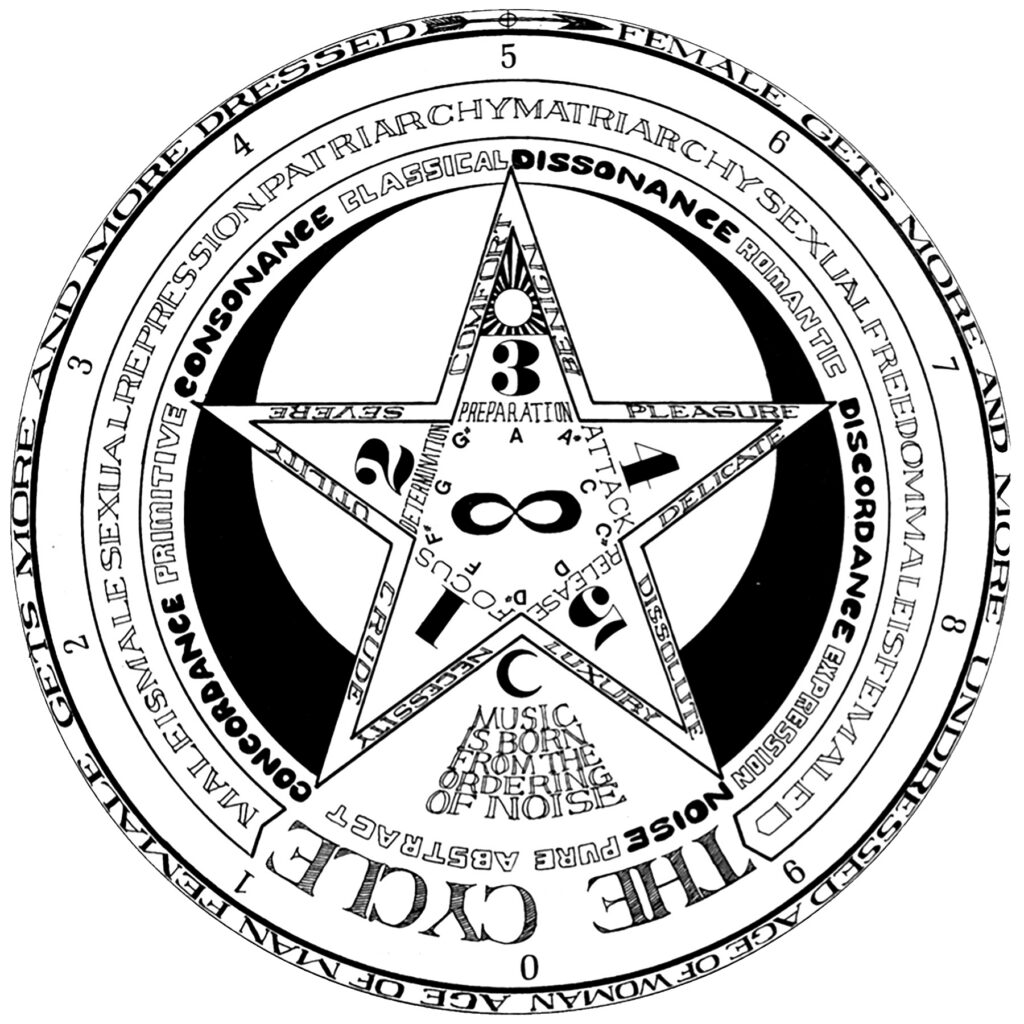
My argument was that the stages of art and music in our culture reflected the five stages in Vico’s theory, and that our society had already entered the fifth and final stage of “luxury”. This was clear to me due to the state of contemporary art and music. In the article, I explained that only when they are living in the fifth stage of a cycle could people grasp the entire cycle and its significance, and I stated that when society had reached the end of the cycle, art and culture would move to the beginning of the next iteration of the historic cycle. I called this “going from five to one” (from luxury to necessity).
While I was writing the article in 1970, I realized that, as the times past, our society would become more deeply enmeshed in a life of luxury, and that sometime in the future, probably during my lifetime, we would reach the inevitable point where society would begin transitioning into the first stage of a new cycle, one based on necessity instead of luxury. This transition would entail the destruction of our current manner of life and the trappings that had been built around it. There would be a return to nature and its laws, and we would become inspired by the examples that had been set by the Amish and the Mennonites, whom I had first encountered in Central America toward the end of our Mexican voyage. It is clear to me that as I write this, we are in the midst of this transition.
On the right side of the cycle in John’s illustration, there is a movement toward matriarchy. I called this “The Age of Woman”, where the female becomes more and more undressed, the male becomes more and more feminine, and there is an advancement toward sexual freedom. On the left side of the illustration, there is a movement toward patriarchy. I called this “The Age of Man”. During this period, the female gets more and more dressed, males become more masculine, and sexual repression advances.
This was a pretty outrageous concept to propose in 1970. Therefore, I did not openly speak about it for many years. However, I believe that now (2025) the fulfillment of the plan that I laid out is genuinely occurring. We are at the end of the fifth stage of the cycle, “five – luxury”, and at the same time, we are entering the beginning of the cycle that will follow in its first stage: “one – necessity”.
The liberal counterculture of the 1960s, of which I had been a part, gave birth to open sexual freedom. Back then, I knew the woman who was the president of San Francisco’s Sexual Freedom League, a group that held parties with open group sex, and the cartoonist R. Crumb’s Zap Comix comic books, popular among the San Francisco counterculture, presented cartoon stories that graphically described total family incest.[1] In 1969, pornography became legal in Denmark, and publications from that country began appearing in stores in the USA. Today, pretty teenage girls can make their livelihood performing sexual acts and masturbating on websites like Chaturbate and OnlyFans. And, as one might expect during a transition from a matriarchy to a patriarchy, massive gender confusion is taking place.
To this day, over fifty years after publishing Kosmon, I still hold to this drawing that I first presented in 1970.
[1] R. Crumb moved from San Francisco to France in 1991 and is famous in Paris.
Four Example Drawings from the Kosmon
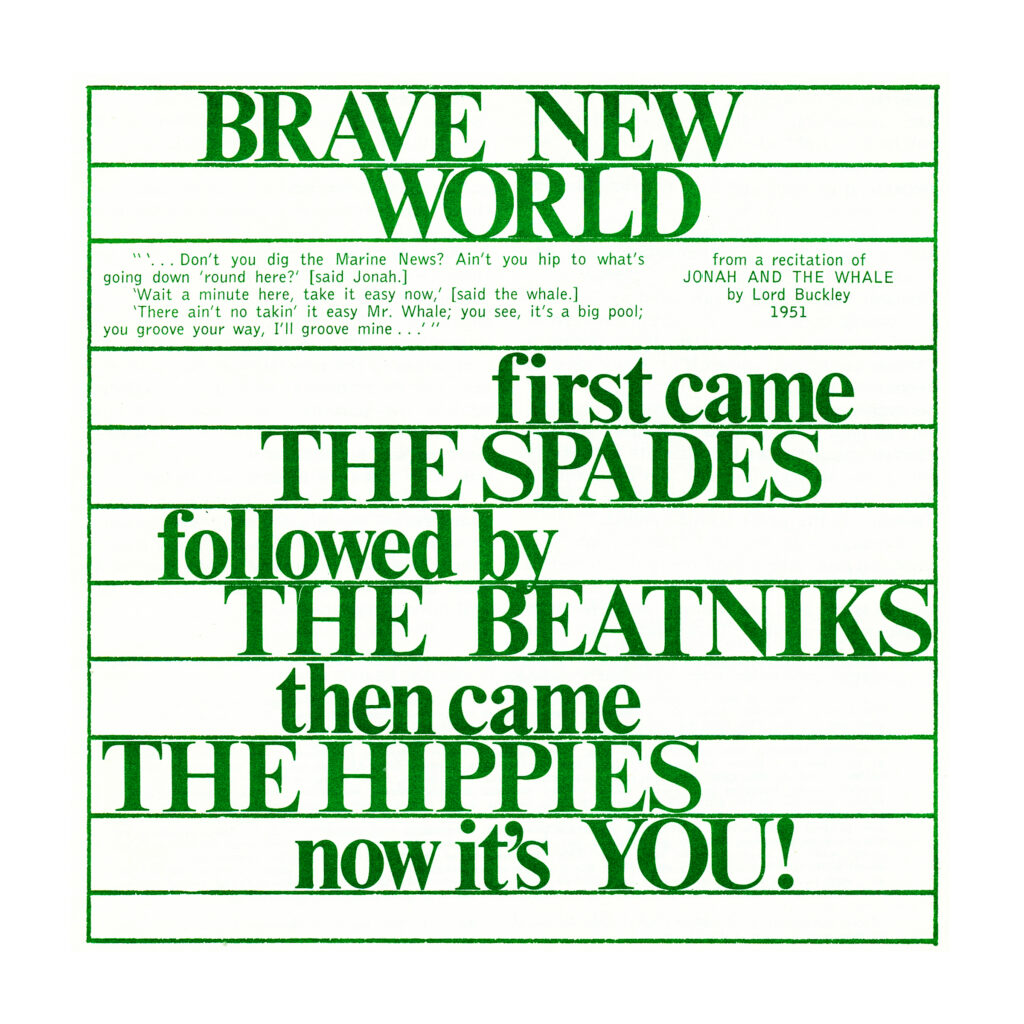
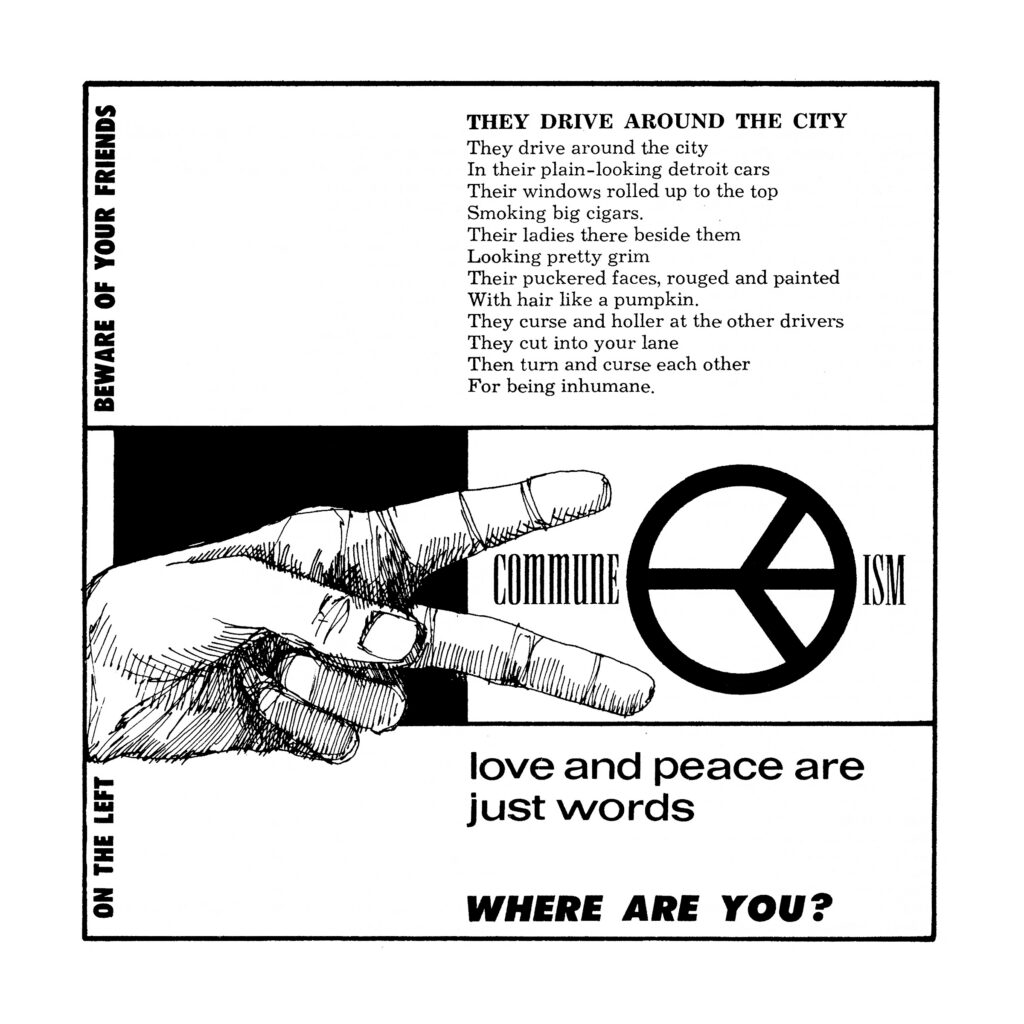
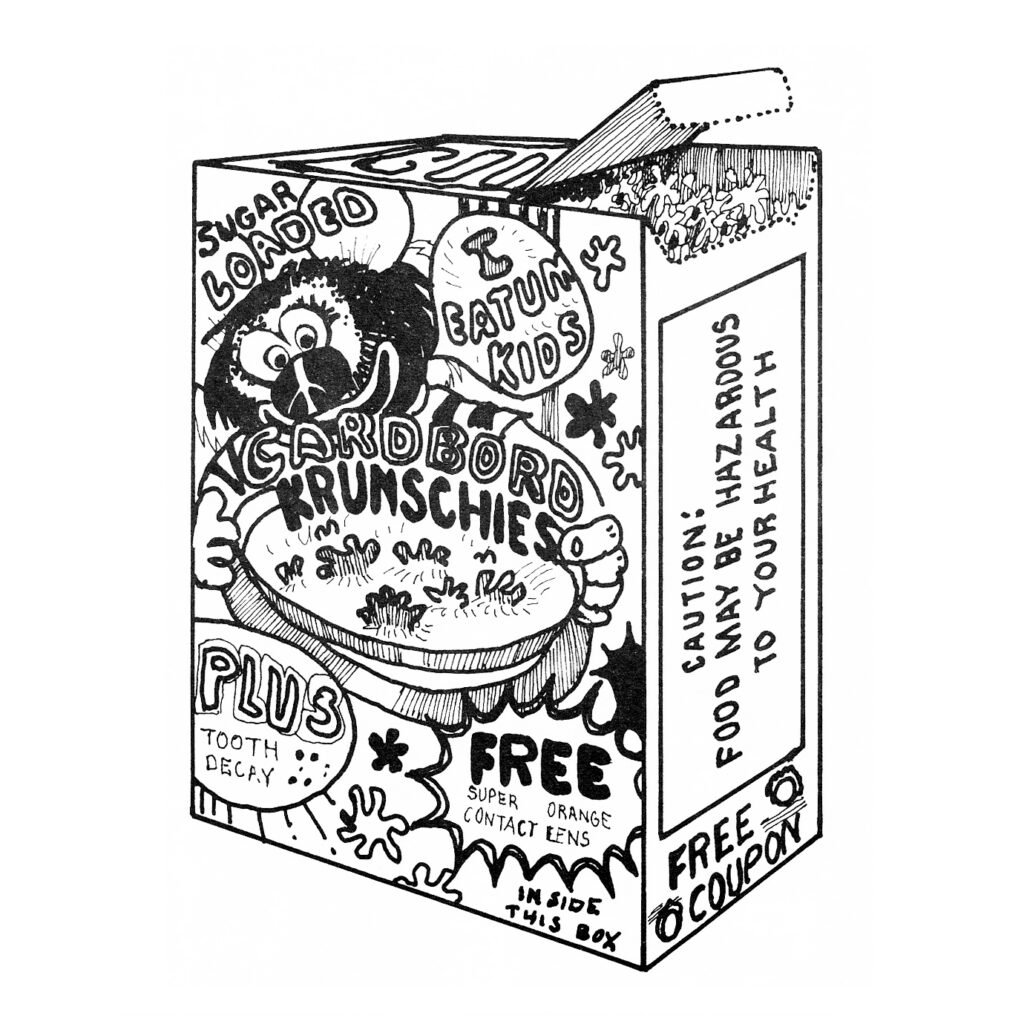
The Kosmon was a part of the 1960s subculture, which grew into the liberal culture of today (The 2020s). From the so-called “Hippy” subculture grew the organic, healthy. farm-produced food subculture of today, the rise in true spiritual consciouness, and the gift to the Western World of North Indian Classical music, all represented in the Kosmon.